Tunneled Left Ventricular Lead During Upgrade to a Biventricular Defibrillator

A very active octogenarian with history of ischemic cardiomyopathy, CAD status post bypass surgery and congestive heart failure (CHF) presented for evaluation. He had a dual chamber defibrillator (ICD) implanted in 2006 because of sustained ventricular tachycardia (VT).  His ejection fraction was 10-15% with extensive infarct and no evidence of ischemia on stress test.  He was having shortness of breath with mild exertion (and resting at times) giving him Class 3/4 CHF.  His electrocardiogram showed left bundle branch block and QRS duration of 160msec.

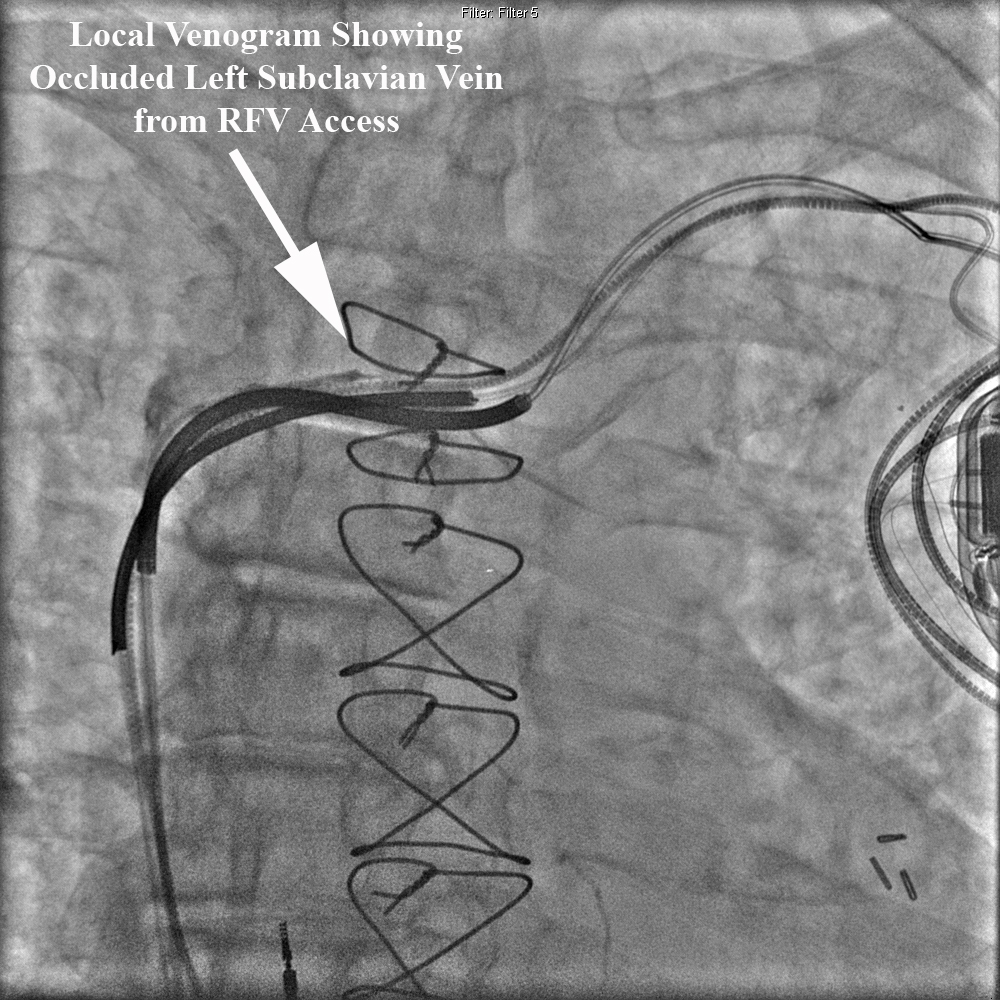
He was scheduled for upgrade of his defibrillator to a biventricular defibrillator with the addition of a left ventricular (LV) lead placed percutaneously in his coronary sinus.  Of note, his initial right ventricular ICD lead (Medtronic Sprint Fidelis) had to be replaced several years ago.  His in-situ ICD still had battery life and the decision was made to assess coronary sinus and left subclavian patiency prior to opening the ICD incision and risking device infection.  Peripheral venogram of his left upper extremity revealed an occluded left subclavian vein in the midline (see Figure).

L Subclav Veno

Right femoral venous access was obtained and a 5French deflectable octapolar EP catheter was used to document coronary sinus patency.  At this point, access to the left subclavian vein was attempted with the EP catheter without success.  A local venogram was then performed using a 5French multipurpose catheter and once again demonstrated an occluded left subclavian vein from the contralateral approach. See Figure below.

Local Venogram

Given the patient’s extreme age, the decision was made not to attempt opening his chronic left subclavian venous occlusion or attempt laser lead extraction of the abandoned RV lead.  We opted to place a coronary sinus LV lead via a patent right subclavian vein and percutaneously tunnel the lead to his existing left sided device.  A 2cm incision was made in the right infraclavicular region and LV lead was placed without difficulty in a posterolateral branch of the coronary sinus.  This lead was anchored to the right prepectoral fascia then tunneled subcutaneously to the exisiting left infraclavicular lead system.  Tunneling was performed without incident and the patient underwent a successful upgrade to a biventricular defibrillator.  The figure below depicts the chest xray and course of the tunneled LV lead. There was minimal postoperative discomfort along the course of the tunneled lead.

PA CXR of Tunneled LV Lead

Ventricular Fibrillation after Elective Percutaneous Coronary Intervention

Case Description:

A 60 year old with past medical history of tobacco abuse was admitted for evaluation of chest pain without significant electrocardiogram (ECG) changes, electrolyte abnormalities or troponin elevation. Stress test revealed fixed inferolateral defects with EF44% and associated hypokinesis. Interestingly, an echocardiogram revealed an EF 55-60% with no regional wall motion abnormalities. Catheterization revealed an obstructive lesion in the PDA that had drug eluting stent successfully placed. Approximately one hour after stent placement routine ECG did not reveal any significant acute changes and patient was asymptomatic (see Figure 1). Approximately 150min after stent placement, the patient had an episode of ventricular fibrillation (VF) that required an external DC cardioversion (see Figure 2). Repeat cardiac catheterization did not reveal stent thrombosis or spasm. The patient underwent an uncomplicated single chamber defibrillator placement the following day.

Figure 1.  EKG Prior to VF Arrest


Figure 2.  Telemetry Strip Showing the VF Arrest


Discussion:

VF arrest during PCI has been reported to have an incidence of 2.1% with higher incidence of VF during right coronary artery PCI. (HUA02) VF arrest during PCI is most commonly precipitated by contrast, ischemia from coronary dissection, embolism, spasm, or catheter manipulation and occurs during the cardiac catheterization. (NIS84) VF arrest after elective percutaneous coronary intervention (PCI) is uncommon. Indeed, an examination of 19,497 patients undergoing PCI revealed a 0.84% incidence of VF and no episodes of VF arrest temporally unrelated to vessel injection were reported. (ADD05) Survivors of VF arrest in the setting of myocardial infarction (MI) have similar mortality to those not experiencing VF arrest during acute MI. (DEJ09) In contrast, mortality in survivors of in-hospital cardiac arrest has been reported as high as 47% during a median followup of 1.3 years. (HEL11) It is unclear if the mechanism of VF arrest in our patient is secondary to PCI or rather a primary VF arrest. There is a prior report of delayed three vessel coronary spasm in a patient receiving paclitaxel drug-eluting stents however, coronary spasm was demonstrated on repeat catheterization in that report. (KIM05) Our patient did not report any ischemic symptoms preceding his VF arrest (though his EKG had subtle ST changes suggesting possible ischemia) nor did his repeat catheterization reveal vessel thrombosis, spasm, or dissection. Additionally, peri- and post-procedural myocardial injury from slow coronary flow, microvascular embolization, and elevated levels of troponin causing reperfusion tissue damage and cardiac dysfunction leads to worse long-term prognosis than those without myocardial injury (ISH08); our patient did not have significantly elevated pre- or post-procedure troponin levels. The time course of ischemia-induced reperfusion changes is likely less than 30minutes based upon prior experimental models of ischemia. (WIL08) Five minutes of coronary artery occlusion avoids increased risk of ventricular arrhythmias in animals and 30 minutes is appropriate for adequate reperfusion. (DAV81,DAV82,RUF79,WIL08) When the left anterior descending artery is transiently occluded in dogs, there is an initial (t=0-2minutes) small decrease in peak R wave amplitude and conduction velocity followed by a large increase in these indices over the ensuing 1-2minutes. (HOL76) There is a rapid return to baseline when occlusion is released and reperfusion occurs. This biphasic response has also been documented in dogs undergoing circumflex artery occlusions lasting 5minutes. (DAV81,DAV82) However, Ruffy et al (RUF79) found that LAD occlusions for 5 minutes in the dog resulted in a decrease in electrogram R wave amplitudes with no biphasic response. The progressive decrease in R wave amplitude (with the subsequent increase in amplitude) has been demonstrated in isolated rabbits hearts during global ischemia over 10 minutes (KAB89), isolated pig hearts during LAD occlusions for 5 minutesJAN86, and humans subject to 60minutes of unresolved ischemia. (VAI94) Of note, these electrical alterations were rapidly reversible upon reperfusion. (HOL76,RUF79,KAB89,JAN86) In summary then, our patient experienced a VF arrest 150min after elective PCI without conclusive evidence of procedural-related ischemia and well outside the conventional 30min window of reperfusion electrical alterations seen in experimental models. The role of defibrillator implantation as secondary prevention in patients like this is unclear.

References:

HUA02 Huang JL, Ting C-T, Chen Y-T, Chen S-A, “Mechanisms of ventricular fibrillation during coronary angioplasty: increased incidence for the small orifice caliber of the right coronary artery,” International Journal of Cardiology, Volume 82, Issue 3 (March 2002), pp. 221-228.

NIS84 Nishimura RA, Holmes DR Jr, McFarland TM, Smith HC, Bove AA, “Ventricular arrhythmias during coronary angiography in patients with angina pectoris or chest pain syndromes,” Am J Cardiol. V. 53, No. 11 (June 1984), pp. 1496-9.

ADD05 Addala S. Kahn JK, Moccia TF, Harjai K, Pellizon G, Ochoa A, O’Neill WW, “Outcome of Ventricular Fibrillation Developing During Percutaneous Coronary Interventions in 19,497 Patients Without Cardiogenic Shock,” Am J Card, V. 96 (2005), pp. 764-765.

HEL11 Helton TJ, Nadig V, Subramanya SD, Menon V, Ellis SG, Shishehbor MH, “Outcomes of cardiac catheterization and percutaneous coronary intervention for in-hospital VT/VF cardiac arrest, Catheter Cardiovasc Interv, [Epub ahead of print], (July 6, 2011).

DEJ09 DeJong JSSG, Marsman RFHenriques JPS, Koch KT, de Winter RJ, Tanck MWT, Wilde AAM, Dekker LRC, “Prognosis among survivors of primary ventricular fibrillation in the percutaneous coronary intervention era,” Am Heart J, V. 158, No. 3 (September 2009), pp. 467-472.

KIM05 Kim JW, Park CG, Seo HS, Oh DJ, “Delayed severe multivessel spasm and aborted sudden death after Taxus stent implantation,” Heart, V. 91, No. 2 (Feb 2005 Feb), e15.

ISH08 Ishiia H, Amanoa T, Matsubarabv T, Murohara T, “Pharmacological Prevention of Peri-, and Post-Procedural Myocardial Injury in Percutaneous Coronary Intervention,” Current Cardiology Reviews, V. 4. No. 3 (August 2008), pp. 223-230.

WIL08 Williams JL, Mendenhall GS, Saba S, “Effect of Ischemia on Implantable Defibrillator Intracardiac Shock Electrograms,” J Cardiovasc Electrophysiology, Vol. 19, No. 3 (March 2008), pp. 275-281.

DAV81 David D, Naito M, Chen CC, Michelson EL, Morganroth J, Schaffenburg M, “R-wave Amplitude Variations During Acute Experimental Myocardial Ischemia: An Inadequate Index for Changes in Intracardiac Volume,” Circulation, V. 63, No. 6 (June 1981), pp. 1364-1370.

DAV82 David D, Naito M, Michelson EL, Watanabe Y, Chen CC, Morganroth J, Schaffenburg M, Blenko T, “Intramyocardial Conduction: A Major Determinant of R-wave Amplitude During Acute Myocardial Ischemia,” Circulation, V. 65, No. 1 (January 1982), pp. 161-167.

RUF79 Ruffy R, Lovelace DE, Mueller TM, Knoebel SB, Zipes DP, “Relationship between Changes in Left Ventricular Bipolar Electrograms and Regional Myocardial Blood Flow during Acute Coronary Artery Occlusion in the Dog,” Circulation Research, V. 45, No. 6 (December 1979), pp. 764-770.

HOL76 Holland RP, Brooks H, “The QRS Complex during Myocardial Ischemia,” Journal Clinical Investigation, V. 57 (March 1976), pp. 541-550.

KAB89 Kabell G, “Ischemia-Induced Conduction Delay and Ventricular Arrhythmias: Comparative Electropharmacology of Bethanidine Sulfate and Bretylium Tosylate,” Journal Cardiovascular Pharmacology, V. 13, No. 3 (1989), pp. 471-482.

VAI94 Vaitkus PT, Miller JM, Buxton AE, Josephson ME, Laskey WK, “Ischemia-induced changes in human endocardial electrograms during percutaneous transluminal coronary angioplasty,” American Heart Journal, V. 127, No. 6 (June 1994), pp. 1481-1490.

JAN86 Janse MJ, “Electrophysiology and electrocardiology of acute myocardial ischemia,” Can J Cardiology, Supp. A (July 1986), pp. 46A-52A.

Complications of Pacemaker Implantation

Approximately 180000 patients undergo pacemaker implantation in the U.S each year [1]. In addition, the extreme elderly are the most rapidly growing segment of the U.S. [2,3] and pacemakers are commonly implanted in this population. There are reports of pacemaker implant complications (generally clinical trials reporting outcomes and incident complication rates) and fewer reports of complication rates in the extreme elderly (with a persistent exclusion of elderly patients from ongoing clinical trials [4]). A comprehensive review of pacemaker implant complications can help improve informed consent in preoperative patients. Major and minor complications are defined based upon prior reports of device-related complications. [5,6,7,8] Major complications have been defined as death, cardiac arrest, cardiac perforation, cardiac valve injury, coronary venous dissection, hemothorax, pneumothorax, transient ischemic attack, stroke, myocardial infarction, pericardial tamponade, and arterial-venous fistula. Minor complications have been defined as drug reaction, conduction block, hematoma or lead dislodgement requiring reoperation, peripheral embolus, phlebitis, peripheral nerve injury, and device-related infection. This chapter will include discussion of common and uncommon complications of pacemaker implantation including associated incidence as well as the associated radiographs and common clinical signs of these complications.
Complications of Pacemaker Implantation

Radiofrequency Ablation for Minimally-Invasive Repair of Mitral Valve Prolapse

The effects of intracardiac ablation have been well characterized (See Effects of RFA) and prior work has suggested that it can be used to repair mitral valve prolapse causing severe mitral regurgitation (MR).  Minimally invasive repair of mitral valve prolapse (MVP) causing severe mitral regurgitation (MR) should increase the rigidity of the valve leaflet, decrease the leaflet surface area, and decrease redundant chordal length. Ex-vivo studies suggest that direct application of radiofrequency ablation (RFA) to mitral leaflets and chordae can effect these repair goals to decrease MR.  We used a naturally occurring model of MVP (similar macroscopically and microscopically to primary MVP in humans) causing severe MR.  RFA was applied to the prolapsed leaflets of the mitral valve and any associated elongated chordae. Mitral regurgitant volume was calculated using the proximal isovelocity surface area method on pre- and post-ablation echocardiograms.  Subjects found to have anterior leaflet, posterior leaflet, and bileaflet MVP prolapse causing severe MR with a mean ejection fraction of 66±3%(±SD) underwent direct RFA. Echocardiograms performed before and after RFA demonstrated a 66.9±20.6% reduction in mitral regurgitant volume.  The first video below shows the severe MR prior to RFA application to leaflets and chordae.  The second video shows the degree of MR 6weeks after RFA applied.  One can note the qualitative decrease in MR that was quantified by doppler.

These data suggest that myxomatous mitral valve repair using radiofrequency energy delivered via catheter may be feasible. Further investigation is necessary to evaluate whether such a technique could be adapted to a percutaneous, closed chest, beating heart environment.

More information about this study can be found at:  http://www.lebanoncardiology.com/downloads/JLW%20JOIC%202008.pdf.

Pathophysiology of Intracardiac Ablation: How Does Ablation Work?

Radiofrequency catheter ablation (RFA) of cardiac tissue has been well-characterized in animal models. Both unipolar (HUA88) and bipolar (TAN91) radiofrequency ablation cause similar acute and chronic effects, the extent of which is determined by the amount of energy applied to the tissue. It has been shown that the application of microwave (LIE98,WOR02), cryogenic (DUB98,WOR02), laser, (WOR02), and ultrasonic (WOR02) energy result in similar cellular damage as radiofrequency energy.

Radiofrequency energy produces cell damage by heating the tissue and causing coagulative necrosis (cell death). These areas of cell death will eventually be replaced with fibrosis (scar tissue). (WOL94,REM98,LIE00) As one increases the energy applied to tissue, one will see an increase in the coagulation area and an increase in thermal damage. (REM98) Interestingly, this technique has been used to stiffen the palate (roof of the mouth) to prevent snoring. (MAI00) It has been speculated that RFA may cause direct valve tissue injury in patients undergoing ablation of accessory pathways.(MIN92) In fact, Wolfsohn et al (WOL94) found that when they accidentally applied energy to one of the valves of the heart they caused a fibrous scar. Another group (TAN91) found pathologic changes in the tricuspid valve when AV node or His bundle ablation was attempted in dogs. These changes included edema, swelling of the spongiosa, degenerative change of collagen fibers, endocardial thickening, and slight fibrosis and destruction of the valvular tissue. Additionally, collagen is the substance in the body that forms the support structure of tissue. Collagen in heart tissue denatures (breaks down) and contracts when heated to >65° CelciusVIC02. In fact, the chordae tendinae also contract when heated to >65° Celcius (VIC02). This contraction of heart tissue has also been noted by another group.LIE00 Though this technique has not been studied on heart valves one can infer that similar cellular changes may occur when this energy is applied to cardiac valves. RFA has been used to stiffen the palate (roof of the mouth) to prevent snoring. (MAI00) In fact, Wolfsohn et al (WOL94) found that when they accidentally applied energy to one of the valves of the heart they caused a similar fibrous scar.

The acute (1-7 days) effects of RFA (50-300J) include a lesion that is round-oval in shape, centrally-pale with varying amounts of a hemorrhagic rim.(HUA88) Occasionally, there is a mural thrombus over the lesion (~20% occurrence). There is central coagulation necrosis, peripheral contraction band necrosis, and interstitial edema and fibrinous material on the endocardium. (TAN91) During days 3-7, one observes a rim of granulation tissue composed of proliferating capillaries and fibroblasts admixed with acute and mononuclear inflammatory cells. (HUA88) Finally, the chronic effects are usually evident at 4-6 weeks after RFA. Chronic lesions are round-oval to irregular in shape, well-circumscribed, and fibrotic.(HUA88) The acute edema has almost disappeared and there are almost mature collagen fibers and a mild increase in elastic fibers.(TAN91) Much of these pathological observations were made in dog models however, Huang et al (HUA88) found that dog tissue damage was very similar to the tissue damage found in postmortem humans. RFA lesion size is, in part, determined by the amount of energy applied (typically, 50-700Joules). However, energy levels of 100-300J have been shown to cause similar lesion sizes (LxWxDepth, ~4.8×4.6×4.3mm) (HUA91). Earlier work by Huang et al (HUA87), demonstrated the application of unipolar RFA with an energy level of 50J caused an average subacute (7-10d) lesion size of 4x4x2mm.

References:

WOL94 Wolfsohn AL, Green MS, and Walley VM, “Pathology of Radiofrequency Catheter Ablation of the Atrioventricular Node,” Modern Pathology, Vol. 7, No. 4 (1994), pp. 494-496.

REM98 Remorgida V, “Tissue thermal damage caused by bipolar forceps can be reduced with a combination of plastic and metal,” Surgical Endoscopy, Vol. 12 (1998), pp. 936-939.

LIE00 Liem LB, Pomeranz M, et al, “Electrophysiological Correlates of Transmural Linear Ablation,” PACE, Vol. 23 (January 2000), pp. 40-46. MAI00 Mair EA and Day RH, “Cautery-assisted palatal stiffening operation,” Otolaryngol Head Neck Surg, Vol. 122 (April 2000), pp. 547-555.

MIN92 Minich LL, Snider AR, Dick M II, “Doppler Detection of Valvular Regurgitation After Radiofrequency Ablation of Accessory Connections,” Am J Cardiol, V. 70 (July 1, 1992), pp. 116-117.

VIC02 Victal OA, Teerlink JR, et al, “Left Ventricular Volume Reduction by Radiofrequency Heating of Chronic Myocardial Infarction in Patients with Congestive Heart Failure,” Circulation, Vol. 105 (March 19, 2002), pp. 1317-1322.

LIE98 Liem LB and Mead RH, “Microwave Linear Ablation of the Isthmus Between the Inferior Vena Cava and Tricuspid Annulus,” PACE, Vol. 21 (November 1998, Part I), pp. 2079-2086.

WOR02 Liem LB, “Catheter Ablation Using Alternative Energy Sources,” EP Lab Digest, (September/October 2002), pp. 10-12. DUB98 Dubuc M, Talajic M, et al, “Feasibility of Cardiac Cryoablation Using a Transvenous Steerable Electrode Catheter,” J Interventional Cardiac Electrophysiology, Vol. 2 (1998), pp. 285-292.

TAM95 Tamura K, Fukuda Y, Ishizaki M, Masuda Y, Yamanaka N, Ferrans V. “Abnormalities in elastic fibers and other connective-tissue components of floppy mitral valve,” Am Heart J, V. 129, No. 6 (June 1995), pp. 1149-1158.

NAS04 Nasuti JF, Zhang PJ, Feldman MD, Pasha T, Khurana JS, Gorman JH III, Gorman RC, Narula J, and Narula N, “Fibrillin and Other Matrix Proteins in Mitral Valve Prolapse Syndrome,” Ann Thorac Surg, V. 77 (2004), pp. 532-536.

DAV78 Davies MJ, Moore BP, Braimbridge MV, “The floppy mitral valve – Study of incidence, pathology, and complications in surgical, necropsy, and forensic material,” Br Heart J, V. 40 (1978), pp. 468-481.

WHI87 Whittaker P, Boughner DR, Perkins DG, Canham PB, “Quantitative structural analysis of collagen in chordae tendinae and its relation to floppy mitral valves and proteoglycan infiltration,” Br Heart J, V. 57 (1987), pp. 264-269.

BAK88 Baker PB, Bansal G, Boudoulas H, Kolibash AJ, Kilman J, Wooley CF, “Floppy Mitral Valve Chordae Tendinae: Histopathologic Alterations,” Hum Pathol, V. 19 (1988), pp. 507-512.

GRA03 Grande-Allen KJ, Griffin BP, Ratliff NB, Cosgrove DM, Vesely I, “Glycosaminoglycan Profiles of Myxomatous Mitral Leaflets and Chordae Parallel the Severity of Mechanical Alterations,” JACC, V. 42, No. 2 (July 16, 2003), pp. 271-277.

HUA88 Huang SKS, Graham AR, Bharati S, Lee MA, Gorman G, and Lev M, “Short- and Long-Term Effects of Transcatheter Ablation of the Coronary Sinus By Radiofrequency Energy,” Circulation, V. 78, No. 2 (August 1988), pp. 416-427.

TAN91 Tanaka M, Satake S, Kawahara Y, Sugiura M, Hirao K, Tanaka K, Kawara T, Masuda A, Nishikawa T, and Kasajima T, “Pathological Aspects of Radiofrequency Ablation of the Canine Atrioventricular Node and Bundle of His: With Special Reference to Chronic Incomplete Atrioventricular Block,” Acta Pathol Jpn, V. 41, No. 7 (1991), pp. 487-498.

HUA91 Huang SKS, Graham AR, Lee MA, Ring ME, Gorman GD, and Schiffman R, “Comparison of Catheter Ablation Using Radiofrequency Versus Direct Current Energy: Biophysical, Electrophysiologic and Pathologic Observations,” JACC, V. 18, No. 4 (October 1991), pp. 1091-1097.

HUA87 Huang SK, Bharati S, Graham AR, Lev M, Marcus FI, and Odell RC, “Closed Chest Catheter Dessication of the Atrioventricular Junction Using Radiofrequency Energy- A New Method of Catheter Ablation,” JACC, V. 9, No. 2 (February 1987), pp. 349-358.

DAV78 Davies MJ, Moore BP, and Braimbridge MV, “The floppy mitral valve: Study of incidence, pathology, and complications in surgical, necropsy, and forensic material,” British Heart Journal, V. 40 (1978), pp. 468-481.

KIN82 King BD, Clark MA, Baba N, Kilman JW, Wooley CF, “Myxomatous Mitral Valves: Collagen Dissolution as the Primary Defect,” Circulation, V. 66, No. 2 (August 1982), pp. 288-296.

COS89 Cosgrove DM and Stewart WJ, “Mitral Valvuloplasty,” Curr Probl Cardiol, V. 14, No. 7 (July 1989), pp. 353-416.

ZOO83 Zook BC, Blackbourne BD, Katz RJ, and Bradley EW, “Mitral Valve Prolapse,” Comparative Pathology Bulletin, Vo. 15 (August 1983), pp.3-4.

Intracardiac Echo (ICE) for Heart Rhythm Procedures

Most intracardiac EP procedures are analogous to painting the inside of a room; I have found that in many procedures, without ICE you are painting in the dark. Charles Darwin said, “It is not the strongest of the species that survives, nor the most intelligent, but rather the one most responsive to change.”  Within the last decade, the field of Electrophysiology has progressed in term of technology and breadth of procedural variety.  Part of this development has been the use of adjunctive imaging during EP procedures.  The following video depicts an ex-vivo heart preparation undergoing a radio frequency ablation.

One can imagine the trauma that a steam pop could cause during an EP study in which the ablation catheter is confined within a small trabeculation in the right or left atrium.  Direct visualization of the ablation electrode-endocardial interface is possible with intracardiac echo (ICE).  ICE permits us to watch for increasing echogenicity of endocardium and possible overheating.  In addition, the development of catheter or sheath thrombus can be detected by direct visualization with ICE.

There are two main types of ICE:  Phased-Array and Radial.


1.  Phased Array:  8-10 French, 5.5–10 Mega Hertz catheter with 90° sectorial sector image and Doppler capability (AcuNav®, Acuson, a Siemens Corporation, Mountain View, California). Phased-array generally offers better image resolution/definition and doppler capability.  The doppler capability permits assessment of valve disorders such as stenosis (blockage) or regurgitation (leaking).  The cost is higher.

2.  Radial (mechanical rotation of the transducer):  8.5 French, 9 MHz catheter with 360° radial image (Ultra ICE, Boston Scientific, Natick, Massachusetts). This catheter has no Doppler capability and image definition is not as good. 360° scan has a larger field of view and allows for a more comprehensive depiction of both atrial chambers and atrioventricular valves with their relationships and it also can be used as IVUS for great vessels.

Floating Potential and Far-Field Left Atrial Appendage Signals During Atrial Fibrillation Ablation

Atrial fibrillation ablations are often like exploring a new forest; there are interesting findings unique to every patient and it is “what keeps you coming back.”  This is an electrogram recorded during an ablation after completing a left atrial pulmonary venous antrum isolation and assessing the left superior pulmonary vein for entrance/exit block. On first exam, it looks as if some work needs to be done but on closer inspection there is evidence of a “floating potential” and far-field sensing of atrial appendage activity.  The longer cycle length electrogram (~3100msec) is a pulmonary vein potential that is firing regularly but not conducting out to the left atrium (exit block).  In addition, the shorter cycle length (~1000msec) is a slightly lower frequency left atrial appendage signal that is often recorded from the proximate left superior pulmonary vein.  I get the “floating potentials” less than 10-20% of cases but it is a welcome finding.

Difficult Access of Coronary Sinus During Attempted Percutaneous LV Lead Insertion

The emergence of resynchronization therapy has led to an increase in attempts at left ventricular lead placement via the coronary sinus (CS).  The MIRACLE study program [LEO05] reported a 91.6% success rate for LV lead placement, while COMPANION [BRI04] revealed an 89%  success rate for LV lead placement.  Another report indicated a similar 92% success rate with LV lead placement. [DIV08]  Though we counsel our patients on a LV lead placement success rate at 88-92%, our center demonstrated a 97% success rate (64 of 66 patients) with LV lead placement within the range from 2:30 to 5:30 o’clock in the left anterior oblique (LAO) view. [WIL10]

There are many reasons for difficult CS access including Thebesian valves, cardiac vein ostial valves, and Chiari networks.  The image shown below is representative of the ostial valve of the coronary sinus (aka, Thebesian valve) that prevents engagement of the CS and ultimately precludes LV lead placement.  Routine attempts at engaging the coronary sinus with deflectable EP catheters as well as hydrophilic guide wires were met without success.  A 9MHz radial intracardiac echo (ICE) probe (UltraICE, Boston Scientific Corp) was introduced via a steerable sheath (Agilis, St. Jude Medical) to evaluate the CS anatomy.  This image demonstrates a Thebesian valve covering the entire CS osmium with no obvious accessible fenestration or defect.  LV lead placement was aborted and patient was referred for epicardial LV lead placement via cardiothoracic surgery.


Prior reviews of CS anatomy (PEJ08) revealed the presence of Thebesian valves in 80% of cases and Chiari networks were found in 10% of cases.  It covered one-fifth in 7%, one-third the os in 29%, one-half in 27%, two-thirds in 14%, and the entire os in 5%.  The average diameter of the CS os was 8mm with a range of 3-15mm.  Appreciation for the anatomic variations of the normal human CS as well as experience with ICE may help reduce complications and improve success of LV lead implantation.

References:

LEO05     Leon AR, Abraham WT, Curtis AB, et al.; for the MIRACLE Study Program, “Safety of Transvenous Cardiac Resynchronization System Implantation in Patients with Chronic Heart Failure: Combined Results of Over 2000 Patients from a Multicenter Study Program,” J Am Coll Cardiol, 2005;46(12):2348–56.

BRI04     Bristow MR, Saxon LA, Boehmer J, et al., “Cardiac-Resynchronization Therapy with or without an Implantable Defibrillator in Advanced Chronic Heart Failure for the Comparison of Medical Therapy, Pacing, and Defibrillation in Heart Failure (COMPANION) Investigators,” N Engl J Med, 2004;350(21):2140–50.

DIV08     D’Ivernois C, Lesage J, Blanc P, “Where are left ventricular leads really implanted? A study of 90 consecutive patients,” Pacing Clin Electrophysiol, 2008;31(5):554–9.

WIL10     Williams JL, Lugg D, Gray R, Hollis D, Stoner M, Stevenson R, “Patient Demographics, Complications, and Hospital Utilization in 250 Consecutive Device Implants of a New Community Hospital Electrophysiology Program,” American Heart Hospital Journal, V. 8, No. 1 (Summer, 2010), pp. 33-39.

PEJ08     Pejkovic B, Krajnc I, Anderhuber F, Kosutic D, “Anatomical Variations of the Coronary Sinus Ostium Area of the Human Heart,” J Int Med Research, V. 36 (2008), pp. 314-321.