Dr. Jeff Williams' Discussion forum for biotechnology, pacemakers, defibrillators, and electrophysiology studies including ablation.
Author: Heart Rhythm Center
Dr. Williams obtained his undergraduate degree with a double major in Biomedical and Electrical Engineering at Vanderbilt University. He was then awarded a Keck Fellowship for graduate school at the University of Pittsburgh where he obtained his Master’s degree in Bioengineering.
Dr. Williams went on to obtain his medical degree at Drexel University in Philadelphia and completed 5 years of Fellowship training in both Cardiovascular Diseases and Clinical Cardiac Electrophysiology at the University of Pittsburgh Medical Center.
His unique background and extensive knowledge of both engineering and cardiology have earned Dr. Williams many accolades in both clinical and academic settings. He’s published over 20 manuscripts and abstracts in the field of cardiology/electrophysiology and has received awards from both the American College of Cardiology Foundation and the National Institutes of Health.
Dr. Williams started in the Invasive Electrophysiology Laboratory at The Good Samaritan Hospital in 2008 and the Heart Rhythm Center published outcomes on pacemaker and defibrillator implantations as well as the safety and efficacy of high frequency jet ventilation during EP studies with ablation under his direction. He is Chair of the Quality Committee at the Florida Chapter of the American College of Cardiology.
Please join us for the Sixth Annual Lebanon Valley Cardiovascular Symposium on Saturday May 30, 2015. It has been very well received by a broad swath of care providers in Pennsylvania. We continue to increase our attendance and registrant feedback was overwhelmingly positive! As you can see, we have a great lineup of faculty and topics for this year’s Symposium.
The 2015 Symposium (Saturday May 30, 2015) will feature Dr. Michael Ezekowitz (Director of Atrial Fibrillation Research & Education, Cardiovascular Research Foundation, Main Line Health) and faculty from the University of Pittsburgh, Jefferson Medical College, WellSpan (York Hospital) and The Good Samaritan Hospital. Topics will include Target Specific Oral Anticoagulants for Atrial Fibrillation, Outpatient Identification of Pulmonary Hypertension, Treatments for Venous Insufficiency, and more. This year we will also have our Electrophysiologists (Drs. Williams and Stevenson) debating rate versus rhythm control for atrial fibrillation.
The Symposium has grown into one of the largest Cardiovascular Symposiums in Pennsylvania and we will again be cosponsored by the PA Chapter of the American College of Cardiology! The Symposium offers 6.5 AMA Category 1 CME credits (including 2 hours patient safety and 10 MOC credits) and registration is free at www.gshleb.org/lvcs.
This is the fifth in a series of short (less than 5minutes), educational videos designed for patients and their care providers to develop a thorough understanding of pacemakers. Lecture 5 What to Expect on the Day of Pacemaker Implant Procedure describes the events that take place on the day of pacemaker implantation. Important topics include hospital registration and check-in, the implant procedure, and post-implant events.
Please see the Patient Education section of Heart Rhythm Center for other lectures in this series.
This is the fourth in a series of short (less than 5minutes), educational videos designed for patients and their care providers to develop a thorough understanding of pacemakers. Lecture 4 Preoperative Workup and Evaluation (Meeting the Implanting Physician) describes the preoperative evaluation for patients preparing to undergo pacemaker implantation. Important topics include the types of physicians that perform pacemaker implantation and questions to ask the doctor to minimize the risk of complications.
Please see the Patient Education section of Heart Rhythm Center for other lectures in this series.
This is the third in a series of short (less than 5minutes), educational videos designed for patients and their care providers to develop a thorough understanding of pacemakers. Lecture 3 What are Pacemakers and How Do They Work? describes the basics of pacemaker implantation and how the pacemakers work.
Your care providers have extensive training assessing the reasons—also called indications—that a patient may need a pacemaker. In particular, it is very important that the benefits of pacemaker implantation outweigh the risks of the pacemaker implant surgery (to be discussed later). The American College of Cardiology (ACC) is one of the major professional societies that develops guidelines to help care providers make educated clinical decisions that are based upon prior clinical studies. This is the basis of “evidence-based” medicine: the process by which clinical ideas are tested, reported, and reevaluated to decide the most appropriate care for a particular condition.
The ACC has developed guidelines that help care providers decide when a patient would be best served by a pacemaker. The easiest rule to remember is: pacemakers are most appropriate for patients who are having symptoms related to an abnormally slow—or at times, fast—heart rate. These symptoms include: shortness of breath, chest pain, dizziness, fainting (also called syncope), heart failure, arrhythmias (such as ventricular tachycardia/fibrillation), or fatigue. The decision to implant a pacemaker also requires evaluation of the permanence of the AV block. Electrolyte abnormalities (like potassium) can cause significant AV block, but correction of the abnormality can lead to resolution of the AV block. Some diseases—like Lyme Disease—often follow a natural course where the AV block is temporary and resolves as the disease is treated. Some types of AV block that occur during periods of vagal activation can reverse very quickly (e.g., nausea and dizziness during a blood draw may cause transient AV block or during sleep in patients with sleep apnea). In addition, after aortic valve surgery, inflammation can cause transient AV block that resolves within days of the operation. Finally, there are some diseases that warrant pacemaker implantation, because the AV block may continue to worsen (for example, sarcoidosis, amyloidosis, or neuromuscular diseases).
Abstract Presented at the Heart Rhythm Society 2014 Annual Sessions, May 8, 2014
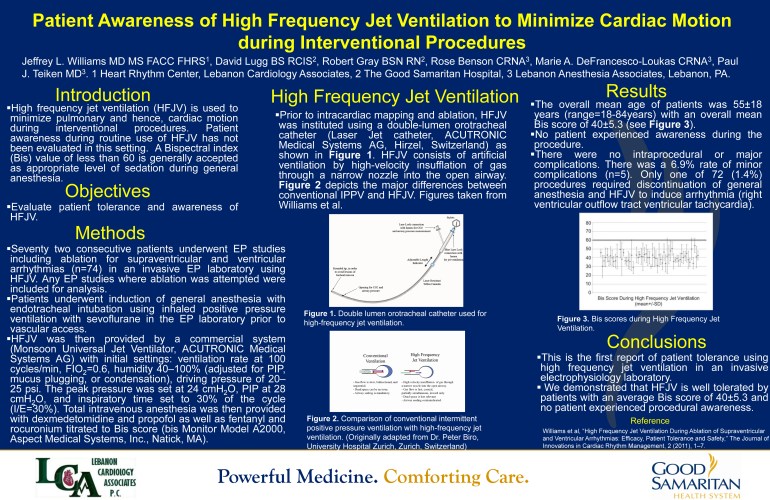
Patient Awareness of High Frequency Jet Ventilation to Minimize Cardiac Motion during Interventional ProceduresAuthors:
Jeffrey L. Williams MD MS FACC FHRS, David Lugg BS RCIS, Robert Gray BSN RN, Rose Benson CRNA, Marie A. DeFrancesco-Loukas CRNA, Paul J. Teiken MD. Heart Rhythm Center, The Good Samaritan Hospital, Lebanon Cardiology Associates, Lebanon Anesthesia Associates, Lebanon, PA.
Introduction: High frequency jet ventilation (HFJV) is used to minimize pulmonary and hence, cardiac motion during interventional procedures. Patient awareness during routine use of HFJV has not been evaluated in this setting. A Bispectral index (Bis) value of less than 60 is generally accepted as appropriate level of sedation during general anesthesia. Methods: Seventy two consecutive patients underwent EP studies including ablation for supraventricular and ventricular arrhythmias (n=74) in an invasive EP laboratory using HFJV. Any EP studies where ablation was attempted were included for analysis. Patients underwent induction of general anesthesia with endotracheal intubation using inhaled positive pressure ventilation with sevoflurane in the EP laboratory prior to vascular access. HFJV was then provided by a commercial system with initial settings: ventilation rate at 100 cycles per minute and drive pressure at 20-25psi. Total intravenous anesthesia was then provided with dexmedetomidine and propofol as well as fentanyl and rocuronium titrated to Bis score. Results: The overall mean age of patients was 55±18 years (range=18-84years) and the overall mean Bis score was 40±5.3 (see Poster). No patient experienced awareness during the procedure. Conclusions: This first report of patient tolerance using high frequency jet ventilation in an invasive electrophysiology laboratory demonstrates that HFJV is well tolerated by patients with an average Bis score of 40±5.3 and no patient experienced procedural awareness.
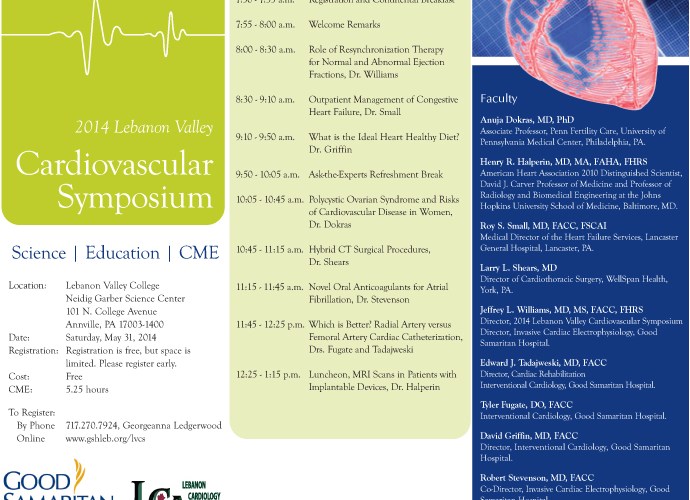
Please join us for the Fifth Annual Lebanon Valley Cardiovascular Symposium on Saturday May 31, 2014. It has been very well received by a broad swath of care providers in Pennsylvania. We continue to increase our attendance and registrant feedback was overwhelmingly positive! As you can see, we have a great lineup of faculty and topics for this year’s Symposium.
The 2014 Symposium (Saturday May 31, 2014) will feature Dr. Henry Halperin (2010 AHA Distinguished Scientist Award Recipient, Johns Hopkins University) and faculty from the University of Pennsylvania, Lancaster General Hospital, WellSpan (York Hospital) and The Good Samaritan Hospital. Topics will include Outpatient Management of CHF, Cardiac Resynchronization Therapy, Novel Oral Anticoagulants for Atrial Fibrillation, and more. This year we will also have two of our Interventionalists (Drs. Tadajweski and Fugate) debating radial versus femoral artery access for cardiac catheterizations.
The Symposium has grown into one of the largest Cardiovascular Symposiums in Pennsylvania and we will again be cosponsored by the PA Chapter of the American College of Cardiology! The Symposium offers 5.25 AMA Category 1 CME credits) and registration is free at www.gshleb.org/lvcs.
Both non-irrigated and irrigated tip catheters for radiofrequency ablation (RFA) can cause steam pops with abrupt impedance rises probably owing to release of steam from excessive heating below the surface. [1] Saline irrigation maintains a low electrode-endocardial interface temperature during RFA at higher powers, which prevents an impedance rise and produces deeper and larger lesions. But you can see higher temperatures deeper in the cardiac wall (~3.5mm) than at the electrode-endocardial interface. This is thought to be due to direct resistive heating rather than by conduction of heat from the surface. [1] This excessive heating may cause water in the endocardium to vaporize into a gas bubble. Continued ablation (and hence heat formation) can cause this bubble to expand with increased pressure. If this gas bubble suddenly bursts inward toward the endocardium or outward to the epicardium, it can cause an audible “pop.”
The following video (courtesy of Dr. Dave Schwartzman, UPMC, Pittsburgh, PA) shows an ex vivo tissue preparation and formation of a steam pop during application of RFA. A significant concern of steam pops is the risk of cardiac perforation. Perforation with tamponade was seen in 1 of 62 (2%) VT ablations where a steam pop occurred. [2] The RFA applications with steam pops had a higher maximum power but did not differ in maximum catheter tip temperature. It reasons that steam pops in the pulmonary veins or atria may pose higher risk of perforation.
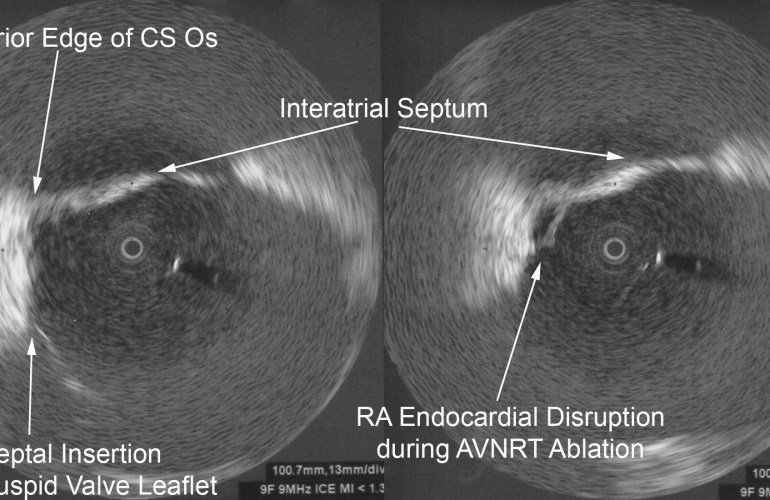
A middle-aged male with no significant medical history underwent an EP study and ablation for typical atrioventricular node reentrant tachycardia (AVNRT). The AVNRT ablation was being guided by radial intracardiac echocardiography. RFA (using power-control setting) is attempted at the anatomic location of the slow AVN pathway region at the anterior edge of the CS os near the septal insertion of the tricuspid valve leaflet (see Figure). Power was titrated from 5W to 30W but required 40W to demonstrate an accelerated junctional rhythm associated with ablation success. A steam pop was felt and evidence of a small defect in the endocardium in the region was noted on radial ICE as shown in Figure. There was no obvious microbubble formation evident on radial ICE prior to the steam pop. Subsequent echocardiograms demonstrated no evidence of perforation or tamponade and patient was asymptomatic at follow-up several weeks later.
Radial ICE showing the anatomic location of the slow AVN pathway and effects of a steam pop after RFA.
References:
1 Nakagawa H et al, “Comparison of In Vivo Tissue Temperature Profile and Lesion Geometry for Radiofrequency Ablation With a Saline-Irrigated Electrode Versus Temperature Control in a Canine Thigh Muscle Preparation,” Circulation (1995), V. 91, pp. 2264-2273.
2 Seiler J et al, “Steam pops during irrigated radiofrequency ablation: feasibility of impedance monitoring for prevention,” Heart Rhythm (Oct 2008), V. 5, No. 10, pp. 1411-1416.
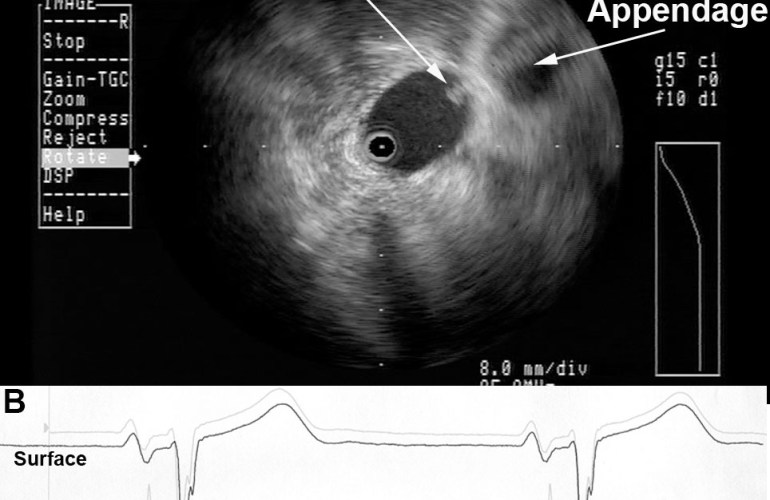
Radial ICE can be used to obtain especially informative electroanatomic correlations and has been described extensively during atrial fibrillation ablations. [1,2,3] Aside from guiding the localization of pulmonary vein potentials during intra left atrial ICE guided procedures (shown in Radial ICE for Left Atrial Procedures) there are several instances where radial ICE facilitated electroanatomic correlates can discern situations where ablation is not necessary during atrial fibrillation ablations. The left atrial appendage is often located quite close to the left superior pulmonary vein and left atrial appendage far-field electrograms can be confused with pulmonary vein potentials if this is not suspected based upon electroanatomic correlation. Figure 1A depicts the radial ICE catheter positioned in the left superior pulmonary vein (adjacent to the left atrial appendage) and 1B shows the intracardiac electrograms (EGM) recorded in the left upper PV (darker, smaller amplitude) and LAA (lighter, larger amplitude); The LUPV signal appears to be a low-pass filtered version of the LAA signal.
Left Atrial Appendage Electrogram Mimicking Left Upper PV Potential
Figure 1 Left Atrial Appendage Electrogram Mimicking Left Upper PV Potential. Image A depicts the radial ICE catheter positioned in the left superior pulmonary vein and B shows the corresponding intracardiac electrogram (EGM) recorded in the left superior PV (darker, smaller amplitude). EGM’s from within the LUPV (darker) and LAA (lighter, larger amplitude) are superimposed.
One can also see potentials derived from contiguous myocardium outside the region subtended by catheter ablation of atrial fibrillation. [2,3] These potentials may be located near the LA roof in region of Waterston’s groove, proximal Bachmann’s bundle, and superior caval musculature. For example, distinct EGM’s can be recorded from within the right superior pulmonary vein that may look like, but do not represent, latent PV potentials.
Myocardial Potential in the Right Upper Pulmonary Vein that may Represent Bachmann’s Bundle Potential
Figure 2 Myocardial Potential in the Right Upper Pulmonary Vein that may Represent Bachmann’s Bundle Potential. The ICE image shows typical right pulmonary venous antral image with the tip of ICE catheter just within the entrance to the RUPV and the RLPV obliquely viewed. The ablation catheter is located on the roof of the RUPV. A myocardial potential located ~28msec after the onset of the surface P wave is shown before (pre-RFA) and after (post-RFA) ablation of pulmonary vein (PV) potential. We surmise (though cannot prove) that this myocardial potential represents Bachmann’s bundle potential (BB).
Figure 2 shows the typical radial ICE view when positioned in the right upper pulmonary vein. There are two distinct EGM’s recorded; the earlier signal ~28 msec after the onset of the surface P wave and the later signal ~70msec after the onset of the surface P wave. The later signal represents a true pulmonary vein (PV) potential that is successfully ablated and the earlier signal remains after the ablation; we surmise (though cannot prove) this represents Bachmann’s bundle potential (BB). This signal can often be seen in the right upper pulmonary vein <30msec after the onset of the surface P wave and its presence does not reflect residual PV potentials. Bachmann’s bundle (also called the interauricular band) has a myoarchitecture that displays parallel alignment of fibers along distinct muscle bundles. [5] Bachmann’s bundle extends from the SVC, crossing the interatrial groove, passing leftward in the left atrium.
Discussion:
Intracardiac radial ICE can provide detailed anatomy, guide catheter ablation, enhance procedural safety, and facilitate ablative strategies; it is readily available but generally underutilized. Furthermore, ICE has utility for reducing fluoroscopy times by rendering the operator less dependent upon traditional fluoroscopic monitoring of catheter movement and position. [4,6] Radial intracardiac echo offers 360º views of cardiac anatomy not commonly encountered with traditional phased array catheter or even transthoracic/transesophageal echo though it offers comprehensive utility in guiding EP procedures.
References:
1 Schwartzman D, Nosbisch J, Housel D. Echocardiographically guided left atrial ablation: characterization of a new technique. Heart Rhythm, V. 3 (2006), pp. 930–938.
2 Schwartzman D, Williams JL, “On the Electroanatomic Properties of Pulmonary Vein Antral Regions Enclosed by Encircling Ablation Lesions,” Europace , V. 11 (2009), pp. 435–444.
3 Chandhok S, Williams JL, Schwartzman DS, “Anatomical analysis of recurrent conduction after circumferential ablation,” J Intervent Card Electrophysiol, V. 27, No. 1 (January 2010), pp. 41-50.
4 Ferguson JD, Helms A, Mangrum JM, Mahapatra S, Mason P, Bilchick K, McDaniel G, Wiggins D, and DiMarco JP, “Catheter ablation of atrial fibrillation without fluoroscopy using intracardiac echocardiography and electroanatomic mapping,” Circ Arrhythm Electrophysiol, V. 2, No. 6 (December 2009), pp. 611-619.
5 HO02 Ho SY, Anderson RH, Sánchez-Quintana D.Atrial structure and fibres: morphologic bases of atrial conduction. Cardiovascular Res. 2002;54:325-336.
6 Khaykin Y, Skanes A, Whaley B, Hill C, Beardsall M, Seabrook C, Wulffhart Z, Oosthuizen, Gula L, Verma A, “Real-time integration of 2D intracardiac echocardiography and 3D electroanatomical mapping to guide ventricular tachycardia ablation,” Heart Rhythm, V. 5, No. 10 (October 2008), pp. 1396-1402.
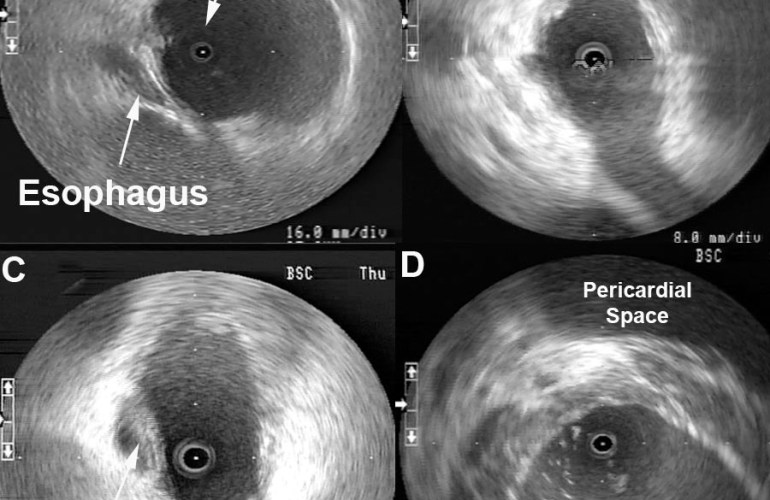
Esophageal Proximity can be monitored to guide locations of ablation to help minimize risk of esophageal damage. The entire length of esophagus that is contiguous with the left atrial posterior wall can be visualized with intra left atrial ICE to monitor ablation delivery and power titration. [1] Figure 1A shows the typical location of the esophagus during an atrial fibrillation ablation. Ablation over the esophagus is avoided or power is titrated to minimize risk of esophageal damage. Endocardial thrombi or coagulum can be detected using radial ICE as shown in Figure 1B. Left atrial damage can also be monitored using radial ICE. Figure 1C shows an unusual case of a tear or rent in the endocardium discovered during an atrial fibrillation ablation. Finally, though radial ICE is not the ideal imaging modality to evaluate for pericardial effusions given its limited far-field resolution. Figure 1D shows the pericardial space in view when an intra-left ventricular ICE position is utilized.
Radial ICE to Monitor for Intraprocedural Complications.
Figure 1 Radial ICE to Monitor for Intraprocedural Complications. Image A shows the left pulmonary vestibule with catheter evident at 9 o’clock and the esophagus viewed obliquely at ~7 o’clock. Image B shows a coagulum versus thrombus adherent to the endocardium. Image C shows a left atrial endocardial tear that did not result in pericardial effusion. Image D shows the pericardial space when ICE catheter positioned across the mitral annulus in the LV.
References:
1 Ren JF, Lin D, Marchlinski FE, Callans DJ, Patel V. Esophageal imaging and strategies for avoiding injury during left atrial ablation for atrial fibrillation. Heart Rhythm. 2006;3: 1156-1161.






 Heart Rhythm Center