Asystole Associated with Ablation near the Left Superior Pulmonary Vein

This is an interesting finding observed during a recent atrial fibrillation ablation performed in our Heart Rhythm Center.  The ablation paradigm has been previously described [1] and consists of a pulmonary venous antrum isolation using entrance and exit block criteria guided by intra left atrial radial intracardiac echocardiography (ICE). During the initial antrum encircling lesion asystole developed (see following figure), ablation was stopped, and sinus rhythm recovered within 10seconds.

Asystole During Ganglionic Plexi Ablation in LSPV

The following radial ICE image demonstrates the ablation catheter location in the superior aspect of the left pulmonary venous antrum near the left atrial appendage.
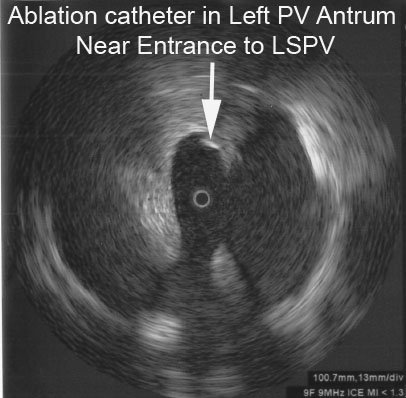
Radial ICE View LSPV Ganglion

Bradycardia is often seen during atrial fibrillation ablations when proximate to autonomic ganglionic plexi.  [2]  I routinely see fluctuations in basal sinus rate during pulmonary venous antrum ablations but this was more dramatic than the sinus rate changes I usually observe.  This location as seen on the intra left atrial radial ICE shot is slightly more anterior than the left superior ganglionic plexus is usually expected.  The following figure shows a CT reconstruction of the posterior left atrium and pulmonary venous antra.  The red dots depict a typical venous antrum ablation lesion set and the yellow areas denote the approximate locations of the ganglionic plexi. [3]  Discontinuation of ablation led to quick restoration of sinus rhythm and repeat ablation near this location to finalize lesion set did not result in repeat asystole or significant fluctuations in sinus rate.


Approximate Locations of Ganglionic Plexi

Another possible explanation for this finding is acute sinus node dysfunction (from damage to the sinus node artery, SNA) during ablation in the anterior left atrium.  Chugh et al present an excellent review of coronary arterial injury during ablation of atrial fibrillation. [4]  Though there was no obvious PR prolongation prior to the pause suggesting an autonomic effect, there was also no obvious sinus tachycardia or acceleration serving as a “harbinger of impending [sinus node] dysfunction.”    Though the SNA arises from the RCA in two-thirds of patients, the remainder of SNA arise from an early branch of the circumflex which “passes superiorly and to the right of the LAA and courses over the anterior LA before terminating at the cavoatrial junction.”  Less commonly, the SNA branches off a more distal portion of the circumflex and ascends in the lateral ridge between the appendage and the left pulmonary veins.  The patient had an uneventful post-ablation recovery.


References:

1                     Schwartzman D, Williams JL, “On the Electroanatomic Properties of Pulmonary Vein Antral Regions Enclosed by Encircling Ablation Lesions,” Europace , V. 11 (2009), pp. 435–444.

2                     Pappone C, et al “Pulmonary vein denervation enhances long-term benefit after circumferential ablation for paroxysmal atrial fibrillation,” Circulation, V. 109 (2004), p. 327.

3                     Katritsis DG et al, “Autonomic Denervation Added to Pulmonary Vein Isolation for Paroxysmal Atrial Fibrillation A Randomized Clinical Trial,” JACC, V. 62 (December 2013), pp. 2318–25.

4                     Chugh A et al, “Manifestations of coronary arterial injury during catheter ablation of atrial fibrillation and related arrhythmias,” Heart Rhythm, V. 10, No. 11 (November 2013), pp. 1638-1645.

Intracardiac Echocardiography May Improve Detection of Implantable Device-Related Endocarditis

A recent article in the Journal of the American College of Cardiology examined the use of intracardiac echocardiography (ICE) to detect cardiovascular implantable electronic device-related endocarditis.  The goal of this study from Narducci et al was to compare transesophageal echocardiography (TEE) and intracardiac echocardiography (ICE) for the diagnosis of cardiac device–related endocarditis (CDI).  The diagnosis of infective endocarditis (IE) was established by using the modified Duke criteria based mainly on echocardiography and blood culture results.

The group prospectively enrolled 162 patients (age 72 ± 11 years; 125 male) who underwent transvenous lead extraction: 152 with CDI and 10 with lead malfunction (control group). They divided the patients with infection into 3 groups: 44 with a “definite” diagnosis of IE (group 1), 52 with a “possible” diagnosis of IE (group 2), and 56 with a “rejected” diagnosis of IE (group 3). TEE and ICE were performed before the procedure. In group 1, ICE identified intracardiac masses (ICM) in all 44 patients; TEE identified ICM in 32 patients (73%). In group 2, 6 patients (11%) had ICE and TEE both positive for ICM, 8 patients (15%) had a negative TEE but a positive ICE, and 38 patients (73%) had ICE and TEE both negative. In group 3, 2 patients (3%) had ICM both at ICE and TEE, 1 patient (2%) had an ICM at ICE and a negative TEE, and 53 patients (95%) had no ICM at ICE and TEE. ICE and TEE were both negative in the control group.

They found that ICE represents a useful technique for the diagnosis of ICM by providing improved imaging of right-sided leads and increasing the diagnostic yield compared with TEE.

Radiofrequency Ablation for Minimally-Invasive Repair of Mitral Valve Prolapse

The effects of intracardiac ablation have been well characterized (See Effects of RFA) and prior work has suggested that it can be used to repair mitral valve prolapse causing severe mitral regurgitation (MR).  Minimally invasive repair of mitral valve prolapse (MVP) causing severe mitral regurgitation (MR) should increase the rigidity of the valve leaflet, decrease the leaflet surface area, and decrease redundant chordal length. Ex-vivo studies suggest that direct application of radiofrequency ablation (RFA) to mitral leaflets and chordae can effect these repair goals to decrease MR.  We used a naturally occurring model of MVP (similar macroscopically and microscopically to primary MVP in humans) causing severe MR.  RFA was applied to the prolapsed leaflets of the mitral valve and any associated elongated chordae. Mitral regurgitant volume was calculated using the proximal isovelocity surface area method on pre- and post-ablation echocardiograms.  Subjects found to have anterior leaflet, posterior leaflet, and bileaflet MVP prolapse causing severe MR with a mean ejection fraction of 66±3%(±SD) underwent direct RFA. Echocardiograms performed before and after RFA demonstrated a 66.9±20.6% reduction in mitral regurgitant volume.  The first video below shows the severe MR prior to RFA application to leaflets and chordae.  The second video shows the degree of MR 6weeks after RFA applied.  One can note the qualitative decrease in MR that was quantified by doppler.

These data suggest that myxomatous mitral valve repair using radiofrequency energy delivered via catheter may be feasible. Further investigation is necessary to evaluate whether such a technique could be adapted to a percutaneous, closed chest, beating heart environment.

More information about this study can be found at:  http://www.lebanoncardiology.com/downloads/JLW%20JOIC%202008.pdf.

Intracardiac Echo (ICE) for Heart Rhythm Procedures

Most intracardiac EP procedures are analogous to painting the inside of a room; I have found that in many procedures, without ICE you are painting in the dark. Charles Darwin said, “It is not the strongest of the species that survives, nor the most intelligent, but rather the one most responsive to change.”  Within the last decade, the field of Electrophysiology has progressed in term of technology and breadth of procedural variety.  Part of this development has been the use of adjunctive imaging during EP procedures.  The following video depicts an ex-vivo heart preparation undergoing a radio frequency ablation.

One can imagine the trauma that a steam pop could cause during an EP study in which the ablation catheter is confined within a small trabeculation in the right or left atrium.  Direct visualization of the ablation electrode-endocardial interface is possible with intracardiac echo (ICE).  ICE permits us to watch for increasing echogenicity of endocardium and possible overheating.  In addition, the development of catheter or sheath thrombus can be detected by direct visualization with ICE.

There are two main types of ICE:  Phased-Array and Radial.


1.  Phased Array:  8-10 French, 5.5–10 Mega Hertz catheter with 90° sectorial sector image and Doppler capability (AcuNav®, Acuson, a Siemens Corporation, Mountain View, California). Phased-array generally offers better image resolution/definition and doppler capability.  The doppler capability permits assessment of valve disorders such as stenosis (blockage) or regurgitation (leaking).  The cost is higher.

2.  Radial (mechanical rotation of the transducer):  8.5 French, 9 MHz catheter with 360° radial image (Ultra ICE, Boston Scientific, Natick, Massachusetts). This catheter has no Doppler capability and image definition is not as good. 360° scan has a larger field of view and allows for a more comprehensive depiction of both atrial chambers and atrioventricular valves with their relationships and it also can be used as IVUS for great vessels.