The following PA and Lateral CXR was obtained the day after an uneventful dual chamber pacemaker implantation placed via left cephalic cutdown.
One can see a radiopaque ribbon near the pacemaker can in both views raising the suspicion of a retained operative sponge. All skin dressings were removed and repeat CXR was performed.
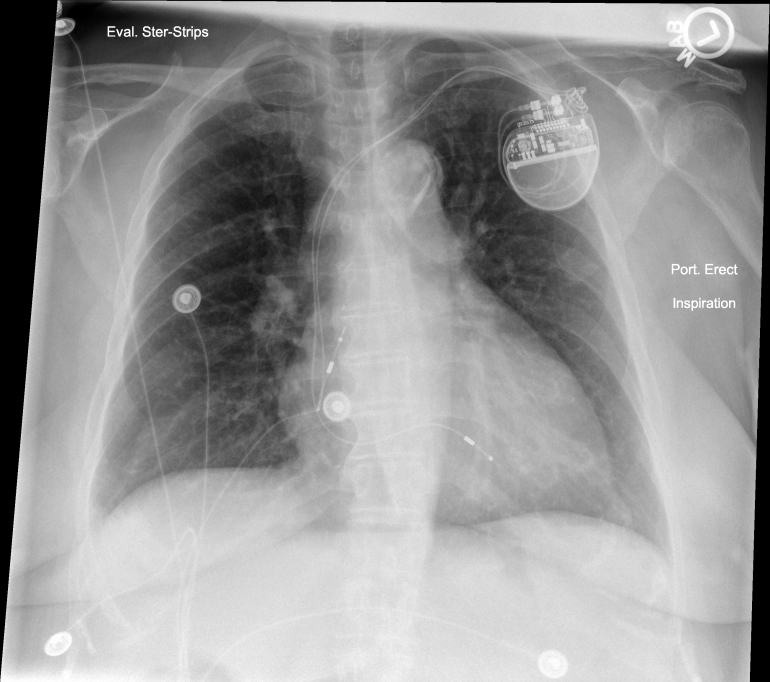
Repeat PA CXR performed after dressing removed leaving steri-strips in place reveals that wound dressing had inadvertently used a radiopaque lap sponge as part of a pressure dressing. Nice case of “pseudo” sponge in the pocket but certainly caused some initial stress during CXR reading!
Published by Heart Rhythm Center
Dr. Williams obtained his undergraduate degree with a double major in Biomedical and Electrical Engineering at Vanderbilt University. He was then awarded a Keck Fellowship for graduate school at the University of Pittsburgh where he obtained his Master’s degree in Bioengineering.
Dr. Williams went on to obtain his medical degree at Drexel University in Philadelphia and completed 5 years of Fellowship training in both Cardiovascular Diseases and Clinical Cardiac Electrophysiology at the University of Pittsburgh Medical Center.
His unique background and extensive knowledge of both engineering and cardiology have earned Dr. Williams many accolades in both clinical and academic settings. He’s published over 20 manuscripts and abstracts in the field of cardiology/electrophysiology and has received awards from both the American College of Cardiology Foundation and the National Institutes of Health.
Dr. Williams started in the Invasive Electrophysiology Laboratory at The Good Samaritan Hospital in 2008 and the Heart Rhythm Center published outcomes on pacemaker and defibrillator implantations as well as the safety and efficacy of high frequency jet ventilation during EP studies with ablation under his direction. He is Chair of the Quality Committee at the Florida Chapter of the American College of Cardiology.
View all posts by Heart Rhythm Center


 Heart Rhythm Center